

Last Updated: November 5, 2026
Quick Summary
Curcumin absorption is better with black pepper because piperine, the compound that gives pepper its bite, slows the body's breakdown of curcumin. This lets more curcumin circulate in the bloodstream for longer instead of being cleared quickly by the liver and gut lining.
- Piperine does not add curcumin; it protects the curcumin you already took by slowing its clearance.
- The 2,000% figure comes from a small human study measuring blood plasma levels, not health outcomes.
- A turmeric and black pepper drink needs both fat and pepper, plus low heat, to support absorption.
- Black pepper can change how the body processes some medications, so talk to your doctor first.
- Without pepper, pair turmeric with fat, gentle heat, or an enhanced absorption formula.
Table of Contents
- Why Curcumin Absorption Is Better With Black Pepper
- What the 2,000% Bioavailability Increase Actually Means
- How Much Turmeric and Black Pepper Should You Take Daily?
- Side Effects of Turmeric and Black Pepper to Watch For
- How to Activate Turmeric Without Black Pepper
- Building a Turmeric and Black Pepper Drink That Works
- Food, Piperine Supplements, or Enhanced Curcumin: Which Fits You
- Check the Label Before You Add Curcumin to Your Routine
- Frequently Asked Questions
Why Curcumin Absorption Is Better With Black Pepper
Curcumin absorption is the main reason turmeric supplements often disappoint. Curcumin, the yellow compound in turmeric, is poorly absorbed on its own (Curcumin: A Review of Its’ Effects on Human Health). Pair it with black pepper, and the story changes. Turmeric is one of the best-known ingredients in liver-focused supplements, and the science on curcumin is worth taking seriously. But that science comes with a catch most labels ignore.
That catch is bioavailability: how much of a compound actually reaches your bloodstream. Curcumin fails this test badly when taken alone. Black pepper contains piperine, a compound that slows the body's breakdown of curcumin (pubmed.ncbi.nlm.nih.gov). The result is more curcumin circulating for longer.
Below, we break down why this pairing works, what the widely cited 2,000% figure really means, and how to use turmeric and black pepper without overdoing it.
Curcumin, Turmeric, and the Bioavailability Problem
Turmeric is a root. Curcumin is the active compound inside it. That distinction matters when you shop, because a jar of turmeric powder is not the same as a curcumin extract.
Bioavailability is the share of a compound that enters your bloodstream and reaches tissue. Curcumin has poor bioavailability. The body clears it fast, and the gut absorbs only a small fraction. Most of what you swallow never makes it into circulation.
Three things work against curcumin:
- It breaks down quickly in the liver and intestinal wall
- It dissolves poorly in water
- It leaves the body faster than it can build up
So the question is not whether curcumin is useful. It is whether your body gets a usable amount. For a deeper look at how turmeric compares with other liver herbs, read our breakdown of milk thistle vs turmeric for liver.
How Piperine Slows Curcumin Breakdown
Piperine is the compound that gives black pepper its bite. In this pairing, it slows the body's clearance of curcumin.
Here is the mechanism in plain terms. After you swallow curcumin, the liver and gut lining process it for removal. Piperine interferes with that process. Curcumin stays in the bloodstream longer, and plasma concentration rises.
A common mistake is thinking black pepper adds curcumin. It does not. It protects the curcumin you already took. That is why the pairing shows up in so much research on curcumin absorption.
What the 2,000% Bioavailability Increase Actually Means
The 2,000% figure is the most repeated number in the turmeric world, and it is also the most misunderstood. It comes from a small human study, not a large trial, and it describes one measured outcome under specific conditions.
Here is the context that usually gets left out. In the study, participants took a fixed dose of curcumin, either alone or with piperine, and researchers measured how much curcumin appeared in blood plasma over time.
Three limits matter when you apply that number to your own kitchen or supplement bottle:
- Dose: the study used a defined curcumin dose with a defined piperine dose. A pinch of pepper on rice does not reproduce those amounts.
- Population: the sample was small, which is typical of early bioavailability research. Small studies are useful signals, not settled conclusions.
- Formulation: the curcumin form, the delivery method, and whether the dose was taken with food all affect absorption. A 2,000% increase in one formulation does not transfer automatically to another.
What the figure does mean is that piperine can substantially change how much curcumin reaches circulation. What it does not mean is that you get twenty times the health benefit, or that any black pepper dose delivers the same effect.
This is also where food and supplements diverge. Culinary amounts of turmeric and pepper are small and variable, and they are not designed to match studied doses.
Watch out: a product label that leads with "2,000% absorption" without stating the curcumin dose, the piperine dose, and the study it references is using the number as marketing, not evidence. For a wider review of which liver ingredients hold up, see our guide to science-backed ingredients for liver detox.
How Much Turmeric and Black Pepper Should You Take Daily?
There is no official daily dose for the turmeric and black pepper combo. Culinary amounts vary widely, and supplement labels should be followed as written.
Start with small amounts and take them with food.
If you use a supplement, follow its label rather than guessing.
Side Effects of Turmeric and Black Pepper to Watch For
Talk with your doctor about any side effects you notice when adding turmeric or black pepper to your routine.
Watch for:
- Stomach upset or nausea from high curcumin doses
- Heartburn from concentrated pepper
- Loose stools when starting a new supplement
Black pepper can change how the body processes some medications. If you take prescription drugs, talk to your doctor before adding a piperine supplement. Our article on how liver supplements interact with medication covers this in more detail.
How to Activate Turmeric Without Black Pepper
Black pepper is the best-known helper, but it is not the only one. If you cannot or will not use pepper, these options can help how to activate turmeric without black pepper:
- Fat: curcumin dissolves in fat, so pair turmeric with oil, milk, or yogurt
- Heat: warm the turmeric gently in fat before adding it to food
- Enhanced formulas: some supplements use forms built for better absorption
- Phospholipid delivery: certain products bind curcumin to fats to improve uptake
None of these match piperine's effect on clearance. They help absorption at the front end rather than slowing breakdown at the back end. Still, they are worth using if pepper is off the table.
Building a Turmeric and Black Pepper Drink That Works
A turmeric and black pepper drink is the easiest way to combine the two. The formula matters more than the ritual.
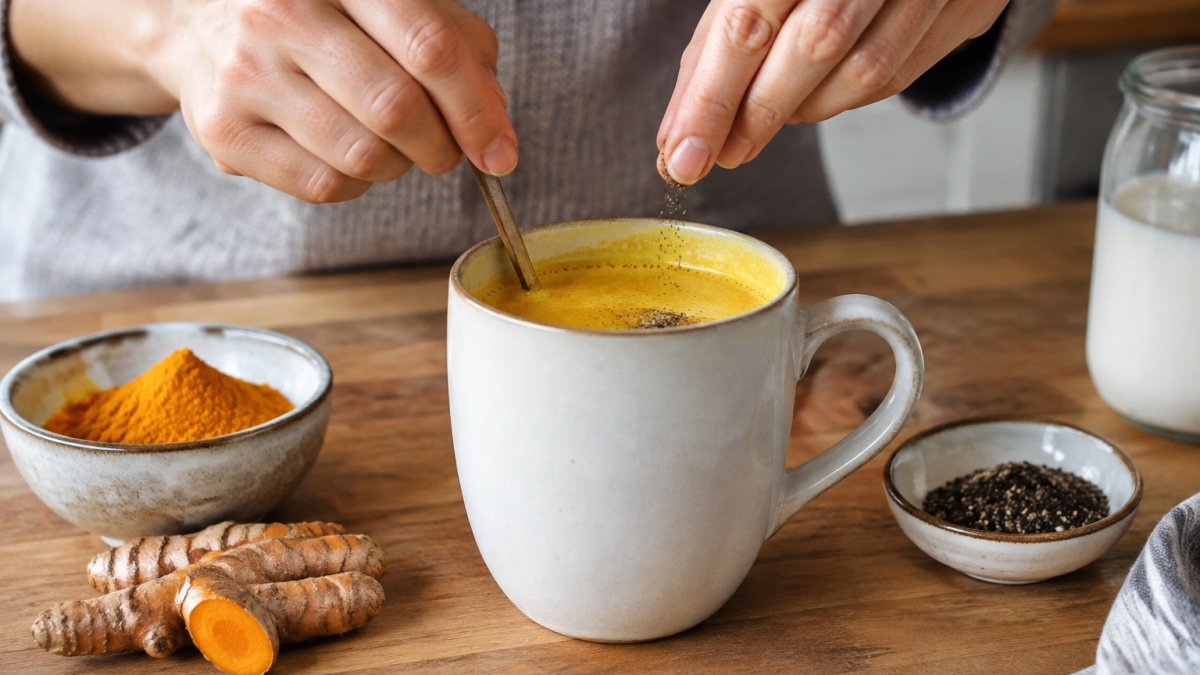
Use this basic recipe:
- Warm one cup of milk or a milk alternative
- Stir in 1/2 teaspoon turmeric powder
- Add a small pinch of black pepper
- Add a teaspoon of a fat like coconut oil or ghee
- Simmer gently for a few minutes, then drink warm
Two details decide whether it works. The fat carries curcumin, and the pepper slows its breakdown. Skip either and you get a pleasant drink with little absorption benefit. Keep the heat low; boiling does not improve anything.
Food, Piperine Supplements, or Enhanced Curcumin: Which Fits You
Three routes get curcumin into your routine, and they are not interchangeable. The right choice depends on whether you want a food habit, a measured dose, or a delivery system built for absorption. Here is how they actually differ.
| Route | What It Delivers | Typical Amount | Best For | Watch Out For |
|---|---|---|---|---|
| Turmeric in food | Small, variable curcumin doses with natural fats and other spices | A fraction of a teaspoon to about half a teaspoon of powder per serving | Daily cooking and gentle support | Low and inconsistent dose per serving |
| Piperine supplement | A measured curcumin dose plus a measured pepper extract | Set by the label, often far above culinary amounts | People who want a consistent dose | Drug interaction risk from piperine |
| Enhanced curcumin | Curcumin formulated for uptake without relying on pepper | Set by the label | Anyone wanting higher absorption without piperine | Higher cost and label reading |
Food is the lowest-risk starting point, but it is also the least precise. A teaspoon of turmeric powder contains only a small amount of curcumin, and the pepper you add is a pinch, not a measured dose.
Piperine supplements give you a consistent dose, which cuts both ways. Piperine can affect how the body processes some drugs by influencing metabolism and transport, so a clinician or pharmacist should review your medication list before you add a piperine product (pubmed.ncbi.nlm.nih.gov).
Enhanced curcumin formulations solve absorption at the source rather than at clearance. They use delivery systems such as phospholipid binding or other absorption technologies, and they typically cost more.
What bioavailability means in practice is narrower than the marketing suggests. A higher blood level tells you more curcumin reached circulation. It does not tell you the right dose for you, and it does not establish that a health benefit follows.
A common pattern is to start with food, move to a measured supplement only if you have a specific reason, and involve a clinician if you take prescription medication. If you want a ready-made option, our Liver Booster pairs turmeric with milk thistle and beet root in one daily formula, made here with clear labeling and purity testing. For help reading the label before you choose, see our guides to third-party tested liver supplements and checking supplement labels.

Check the Label Before You Add Curcumin to Your Routine
Labels tell you more than the front of the bottle. Before you buy any curcumin product, check three things.
First, does it list black pepper or piperine, and how much? A product that claims enhanced absorption should show the mechanism. Second, is the curcumin dose stated clearly, or hidden in a blend? Third, is the product third-party tested?
Our guides to third-party tested liver supplements and checking supplement labels walk through what to look for. A supplement that skips these basics is not worth your money, no matter how good the marketing sounds.
Frequently Asked Questions
Does black pepper help you absorb turmeric better?
Yes. Black pepper contains piperine, a compound that slows the liver and intestinal enzymes responsible for breaking down curcumin. In one often-cited human study, adding 20 mg of piperine to 2 g of curcumin raised plasma concentration by roughly 2,000%. That figure comes from a single small study, so treat it as a direction rather than a guarantee. The practical takeaway: a pinch of black pepper with turmeric, or a formula that pairs them, gives your body more time to absorb the curcumin before it is cleared.
How much turmeric and black pepper should you take daily?
There is no official daily dose for turmeric and black pepper. Culinary amounts vary, and supplement labels should be followed as written. Take it with a meal containing fat, and check with your doctor if you take prescription medication, since piperine can affect drug metabolism.
Can you take curcumin without black pepper?
You can, but absorption will be lower. Curcumin is poorly absorbed on its own because it breaks down quickly in the intestines and liver. If you skip black pepper, options include enhanced-bioavailability formulations such as curcumin phytosome or micellar curcumin, which wrap the compound for better intestinal absorption. Some people simply prefer the taste of turmeric without pepper, and a quality enhanced formula covers that gap. Food-level turmeric in cooking still delivers some benefit even without pepper.
Who should avoid turmeric and black pepper supplements?
Talk to your doctor first if you take blood thinners, diabetes medication, or drugs processed by the liver, because piperine can change how those medications are absorbed and metabolized. People with gallstones, bile duct issues, or scheduled surgery should also check before starting curcumin. High doses can cause stomach upset, and black pepper in large amounts may irritate the gut. For most healthy adults, food-level amounts of turmeric and pepper are well tolerated, but supplement doses deserve a conversation with a clinician.
Getting curcumin to work is really a question of delivery, not hype. If you want a formula that pairs turmeric with supportive liver ingredients and clear labeling, Renew Liver Booster offers a daily option built for exactly that. Our formula combines turmeric, milk thistle, and beet root, is made here with tested purity, and supports your liver's natural detox and regeneration. Get started with Renew Liver Booster and give your liver daily support you can actually trace on the label.
