

Table of Contents
- Milk Thistle vs Turmeric: Side-by-Side Comparison
- How Milk Thistle and Turmeric Work in the Liver
- Can You Take Milk Thistle and Turmeric Together?
- Milk Thistle Dosage for Liver Support
- Turmeric Supplement Liver Injury: What You Need to Know
- Milk Thistle Liver Side Effects and Safety Concerns
- Evidence for Fatty Liver Disease and Liver Enzymes
- Which Supplement Should You Choose?
- Frequently Asked Questions
Last Updated: October 5, 2026
Milk Thistle vs Turmeric: Side-by-Side Comparison
When comparing milk thistle vs turmeric for liver health, you're looking at two herbal supplements with different active compounds. Milk thistle contains silymarin; turmeric's primary active ingredient is curcumin.
The choice depends on your liver condition, medication interactions, and what the evidence supports.
At Renew Liver Booster, we've reviewed the clinical evidence on both. Our formulation combines milk thistle and turmeric with complementary ingredients like beetroot and artichoke extract.

| Supplement | Active Compound | Primary Mechanism | Best Evidence | Key Consideration |
|---|---|---|---|---|
| Milk Thistle | Silymarin | Hepatoprotection, antioxidant | Liver disease, cirrhosis | Generally well-tolerated; limited evidence for fatty liver |
| Turmeric | Curcumin | Anti-inflammatory, antioxidant | Inflammation markers | Liver injury risk at high doses; bioavailability concerns |
How Milk Thistle and Turmeric Work in the Liver
Milk thistle and turmeric support liver health through distinct pathways, which explains why they're often used together and why their effects aren't interchangeable.
Silymarin and Liver Protection
Silymarin, milk thistle's active compound, works primarily as a hepatoprotectant: it may shield liver cells from damage, stabilize cell membranes, support regeneration, and neutralize free radicals.
The strongest evidence for milk thistle centers on chronic liver disease and cirrhosis, where practitioners often recommend it for hepatitis C or alcohol-related damage. Evidence for non-alcoholic fatty liver disease (NAFLD) is weaker: some studies show modest liver enzyme improvements, others minimal effect.
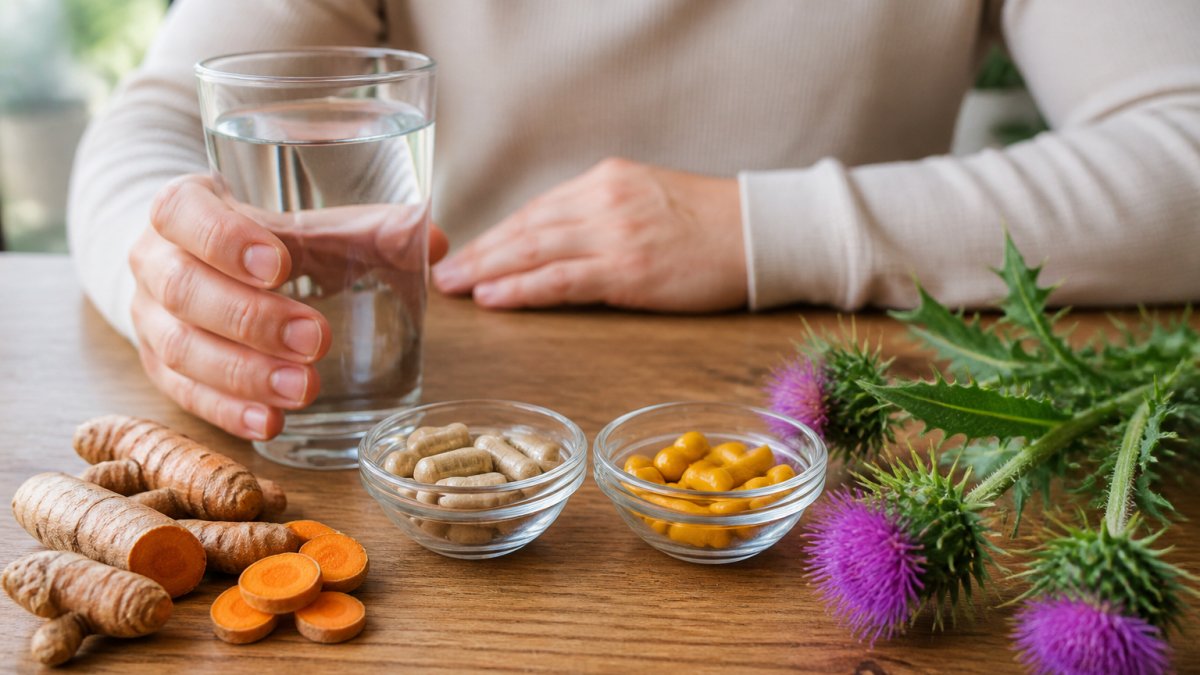
A key advantage is milk thistle's safety profile: used for centuries, serious adverse effects are uncommon, though some experience mild digestive upset.
Curcumin and Inflammation
Curcumin, turmeric's primary active ingredient, targets inflammation and oxidative stress by modulating inflammatory pathways and reducing pro-inflammatory molecules, important because chronic inflammation drives fibrosis and disease progression.
Curcumin's anti-inflammatory action is well-documented in lab and animal studies; human evidence is mixed. Some research shows reduced liver enzymes (ALT and AST), while other studies show no significant effect.
A critical issue is bioavailability: curcumin is poorly absorbed, and even with piperine enhancers, blood levels remain low after oral dosing, raising questions about whether oral turmeric delivers enough curcumin for meaningful liver effects.
Can You Take Milk Thistle and Turmeric Together?
Yes, many people take milk thistle and turmeric together, and the combination is generally considered safe for most adults.
However, "safe together" doesn't mean automatically better. Evidence for combined use is limited, most research examines each ingredient separately.
Drug interactions are the primary concern: both can affect how your body metabolizes medications.
A practical approach: start with one supplement, monitor for 4-8 weeks, then add the second if needed.
Milk Thistle Dosage for Liver Support
Standard milk thistle dosage ranges from 420 to 600 mg daily, divided into two or three doses.
Potency varies significantly.
Duration matters: milk thistle isn't a quick fix. Most studies run 8-12 weeks minimum before measuring effects.
Renew Liver Booster contains milk thistle powder in its comprehensive formula. Suggested use is two capsules daily with water, providing consistent support without calculating individual doses.
Turmeric Supplement Liver Injury: What You Need to Know
Turmeric in food is not the same product as a concentrated curcumin supplement, the single most important distinction for turmeric's liver safety profile.
Culinary turmeric delivers well under 100 mg of curcumin per serving alongside the root matrix. Concentrated supplements can deliver 500-2,000 mg per dose, often with absorption enhancers like piperine or as phytosomes, a different exposure profile entirely.
What the Safety Signal Actually Shows
Herb-induced liver injury from turmeric and curcumin supplements is documented in the medical literature and tracked in the NIH LiverTox database. Cases are rare but real, and the pattern warrants caution:
- Most reported cases involve concentrated curcumin supplements, not culinary turmeric.
- Many involve higher daily doses (commonly cited thresholds are above 1,000-2,000 mg of curcumin per day).
- Some involve enhanced-bioavailability formulations, which deliver more curcumin to the liver than plain powder would.
The mechanism isn't fully understood. Curcumin is metabolized in the liver, and in susceptible individuals this may produce reactive intermediates or trigger an immune-mediated reaction. Genetic variation in liver enzyme activity likely explains why two people can take the same dose with very different outcomes.
Who Is at Higher Risk
You should be more cautious about concentrated curcumin supplements if any of the following apply:
- You have an existing liver condition (fatty liver, hepatitis, cirrhosis)
- You take medications that stress the liver (certain antibiotics, antifungals, methotrexate, some seizure medications, high-dose acetaminophen)
- You drink alcohol regularly
If any apply, talk to your clinician before starting a concentrated curcumin product, and ask whether a lower dose or different supplement makes more sense.
Warning Signs: When to Stop and When to Get Help
- Yellowing of the skin or eyes (jaundice)
- Dark, tea-colored urine
- Pale or clay-colored stools
Seek emergency care if symptoms are severe, worsening rapidly, or accompanied by confusion, easy bleeding, or swelling in the abdomen or legs.
These symptoms can have other causes, so the point isn't to self-diagnose, it's to know when to get evaluated.
A Practical Monitoring Approach
If you choose to take a curcumin supplement:
- Keep the dose moderate. Many clinicians suggest staying at or below 500-1,000 mg of curcumin daily unless a specific reason justifies more.
- Get a baseline. Have liver enzymes (ALT, AST, alkaline phosphatase, bilirubin) checked before you start, especially if you have any liver condition.
- Re-check at 8-12 weeks. This is when supplement-related liver enzyme changes typically show up.
- Don't stack hepatotoxic inputs. If you're also drinking heavily, taking acetaminophen near the daily limit, or using other liver-stressing medications, the risk profile changes.
- Buy from a manufacturer that third-party tests. Contamination and mislabeling are real problems in the supplement market.
The Bottom Line on Turmeric Safety
Turmeric as a spice is not a liver concern for most people. Concentrated curcumin supplements carry a different risk profile, and the risk, while rare, is not zero. Those most likely to reach for high-dose curcumin are also most likely to be in the higher-risk group, so the decision belongs in a conversation with a clinician, not a shopping cart.
Milk Thistle Liver Side Effects and Safety Concerns
Milk thistle is one of the safest herbal supplements available, but not side-effect-free.
Allergic reactions are possible, especially in people allergic to Asteraceae plants (ragweed, chrysanthemums, daisies).
Milk thistle can interact with medications metabolized by the liver's cytochrome P450 system.
Pregnancy and nursing: standard guidance is to avoid milk thistle, though serious adverse events are virtually unreported.
Product quality is often overlooked: some milk thistle supplements contain minimal silymarin or heavy metal contamination.
Evidence for Fatty Liver Disease and Liver Enzymes
Most articles treat milk thistle and turmeric as if the evidence is interchangeable. It isn't: strength differs by condition, by endpoint (liver enzymes vs. imaging vs. symptoms), and by study design. Here's how the evidence grades out.
How to Read the Evidence
Three things separate strong studies from weak ones here:
- Endpoint. Changes in ALT and AST are easy to measure but don't always reflect what's happening inside the liver. Imaging (ultrasound, MRI-PDFF) and biopsy are harder endpoints but more meaningful.
- Standardization. A study using a standardized silymarin extract at 140 mg three times daily is not comparable to one using unstandardized milk thistle powder. The same applies to curcumin, a study using plain curcumin powder is not comparable to one using a phytosome or piperine-enhanced formulation.
- Duration. Liver enzyme changes typically take 8-12 weeks to appear. Studies shorter than that often show nothing because they stopped too early.
Milk Thistle: Evidence by Condition
| Condition | Evidence Strength | What Studies Generally Show |
|---|---|---|
| Cirrhosis (alcohol-related or viral) | Moderate | Modest improvements in liver enzymes and, in some trials, improved survival in subgroups; not a cure |
| Chronic hepatitis C | Weak to moderate | Small reductions in ALT/AST; no consistent effect on viral load |
| Non-alcoholic fatty liver disease (NAFLD) | Weak | Mixed results; some trials show ALT/AST improvement, others show none |
| General liver 'support' in healthy adults | Insufficient | Very little controlled data |
The pattern is consistent: milk thistle's strongest signal is in chronic liver disease, not fatty liver, the opposite of what many marketers imply.
Turmeric / Curcumin: Evidence by Condition
| Condition | Evidence Strength | What Studies Generally Show |
|---|---|---|
| NAFLD / metabolic-associated fatty liver | Weak to moderate | Some trials show reduced ALT/AST and improved metabolic markers; results vary with formulation |
| Elevated inflammatory markers | Moderate | Consistent reductions in CRP and other inflammatory markers in some populations |
| Cirrhosis | Insufficient | Very little controlled human data |
| General liver 'support' in healthy adults | Insufficient | Very little controlled data |
Curcumin's anti-inflammatory mechanism is well-documented in lab and animal models. In humans the picture is muddier, absorption is so poor it's hard to know whether a null result means curcumin doesn't work or never reached the liver in meaningful amounts.
The Head-to-Head Problem
Almost no article addresses this directly: there is very little direct comparative evidence. The vast majority of studies test one ingredient against placebo, not milk thistle against turmeric, so any claim that one is 'better' for the liver is an inference, not a finding.
What you can say with confidence:
- Both have been studied for liver-related endpoints.
- Milk thistle has the longer safety record and the stronger signal in chronic liver disease.
- Turmeric has the stronger signal for inflammation and metabolic markers, but with a real (if rare) liver-injury concern at high doses.
What This Means Practically
For fatty liver, the honest position is that lifestyle change, weight loss, reduced refined carbohydrates, limited alcohol, regular activity, remains the foundation of management. Supplements may support liver enzymes or reduce oxidative stress, but they are adjuncts, not treatments.
If you want to test whether either supplement helps you personally:
- Pick one, not both, so you can attribute any change.
- Use a standardized product (70-80% silymarin for milk thistle; an enhanced-bioavailability curcumin for turmeric).
- Get baseline liver enzymes drawn before you start.
NIH LiverTox database for herb-induced liver injury reports
Which Supplement Should You Choose?
The answer depends on your situation and what your liver needs most.
Choose milk thistle if:
- You have cirrhosis or chronic hepatitis
- You're concerned about liver cell protection and regeneration
- You want the most established safety record
Choose turmeric if:
- You have significant inflammation (elevated inflammatory markers)
- You're managing metabolic syndrome or insulin resistance alongside liver issues
- You want broader anti-inflammatory benefits beyond liver support
Choose both together if:
- You want comprehensive support addressing both protection and inflammation
- You've discussed it with your doctor and have no contraindications
- You're committed to monitoring your response over 12+ weeks
The most important decision isn't which supplement to take, but whether you're addressing root causes.
For a formulated approach combining both ingredients with complementary compounds, Renew Liver Booster provides milk thistle, turmeric, and beetroot in a single daily supplement.
Before starting any supplement, especially with liver disease or medications, consult your healthcare provider. Liver health is too important to guess about.
The gap between wanting to improve your liver health and actually doing it often comes down to choosing the right support. Renew Liver Booster combines the evidence-backed ingredients discussed here, milk thistle, turmeric, and supporting compounds, into a formula made in the USA with rigorous quality standards. Add to cart and start supporting your liver's natural detoxification and regeneration process today.
Frequently Asked Questions
Can turmeric and milk thistle be taken together?
Yes, you can take milk thistle and turmeric together. Both supplements target liver health through different mechanisms, milk thistle through silymarin's hepatoprotective compounds and turmeric through curcumin's anti-inflammatory action. No direct contraindication exists between them. However, if you're on blood thinners, have gallbladder issues, or take medications that interact with either supplement, consult your healthcare provider before combining them. Some people take both to address multiple aspects of liver support.
Can turmeric supplements cause liver injury?
Turmeric is generally safe at standard doses, but high-dose curcumin supplements (over 2,000 mg daily) have been linked to rare cases of liver injury in clinical reports. Most cases involved prolonged use at excessive doses. People with existing liver disease, those taking medications metabolized by the liver, or individuals on blood thinners face higher risk. Start with recommended dosages and monitor for symptoms like dark urine, abdominal pain, or yellowing skin. Discuss turmeric supplementation with your doctor if you have liver disease or take multiple medications.
What is the right milk thistle dosage for liver support?
Standard milk thistle dosages range from 150 to 300 mg of silymarin (the active compound) per day, typically divided into two or three doses. Most clinical studies on liver health used 140-210 mg of silymarin three times daily. Dosage depends on the standardization of your extract, look for products standardized to at least 70-80% silymarin. Start at the lower end and increase gradually if needed. Always follow the product label and consult your healthcare provider, especially if you have liver disease or take medications that affect liver function.
Does milk thistle cause side effects?
Milk thistle is well-tolerated in most people, but side effects can occur. Common mild effects include digestive upset, nausea, and loose stools, especially at higher doses. Rare allergic reactions have been reported in people sensitive to plants in the daisy family. Milk thistle may interact with medications metabolized by the liver or affect blood sugar control in people with diabetes. If you experience persistent digestive symptoms, allergic signs, or unusual fatigue, stop use and consult your doctor. Pregnant or nursing women should avoid milk thistle without medical approval.