

Last Updated: October 28, 2026
Quick Summary
Supplement quality control is verified at home by checking for a current third-party seal, confirming it on the certifier's database, and reading the label for exact ingredient amounts. For deeper proof, request a certificate of analysis matching your bottle's lot number. Together these steps show whether a product contains what its label claims.
- A third-party seal is the fastest filter, but confirm it on the certifier's own website.
- Certification must be renewed, so check the listed status and most recent review date.
- Vague proprietary blends hide individual amounts and make a product harder to verify.
- A useful certificate of analysis matches your lot number and names an accredited lab.
- Good traceability links each bottle to its batch, raw materials, and facility records.
Table of Contents
- What Supplement Quality Control Actually Covers
- Step 1: Check Whether the Product Carries a Third-Party Seal
- Step 2: Confirm the Certification Is Current
- Step 3: Read the Label Like a Verification Document
- Step 4: Request and Interpret a Certificate of Analysis
- Step 5: Check Batch Traceability and Manufacturing Practices
- Using Your Checklist Before Your Next Supplement Purchase
- Frequently Asked Questions
What Supplement Quality Control Actually Covers
Supplement quality control is the set of checks that confirm a product contains what its label says, in the amounts stated, and nothing harmful. The FDA does not approve supplements before they reach shelves, which means the burden of verification falls largely on the buyer (the FDA).
Quality control covers four main areas: identity, potency, purity, and manufacturing. Identity asks whether the product contains the ingredients listed. Potency asks whether those ingredients appear in the stated strength. Purity asks whether contaminants such as heavy metals or microbes are present above safe limits. Manufacturing asks whether the facility follows good manufacturing practices.
Most shoppers stop at reading the front of the bottle. The back label, the seals, and the documentation behind the product tell a much fuller story.
Step 1: Check Whether the Product Carries a Third-Party Seal
A third-party seal means an independent organization tested the product or audited the company behind it. This is the fastest filter you can apply.
Several organizations offer these programs, including USP Verified Dietary Supplement Program, NSF International, and ConsumerLab.
Keep these points in mind:
- Seals are program-specific. A seal from one certifier does not cover every claim on the label.
- Seals can be displayed without current certification. Always verify the status on the certifier's database.
- No seal does not mean poor quality. Many good manufacturers simply skip the cost of certification.
Watch out: A seal printed on a bottle can be a counterfeit or an expired mark. Verification on the certifier's site is the only reliable check.
Recognizing a USP Verified Mark
The USP Verified mark appears as a circular or rectangular logo that reads "USP Verified" on the packaging. USP verification means the product was tested to USP standards for identity, strength, purity, and dissolution, and that the manufacturing site was audited. You can search the USP Verified product database to confirm a specific product and lot.
Step 2: Confirm the Certification Is Current
Certification is not permanent. Companies must renew their programs and pass periodic audits. A product that was verified two years ago may no longer hold that status.
To confirm currency:
- Note the product name, brand, and any lot or batch number on the label.
- Search the certifier's public database for that exact product.
- Check the listed status and the date of the most recent review.
- Save or screenshot the result for your records.
If the product is missing from the database, the seal on the bottle may be outdated. Contact the manufacturer and ask for their current certificate of certification.
Step 3: Read the Label Like a Verification Document
The supplement label is more than marketing. It is a list of claims you can check.
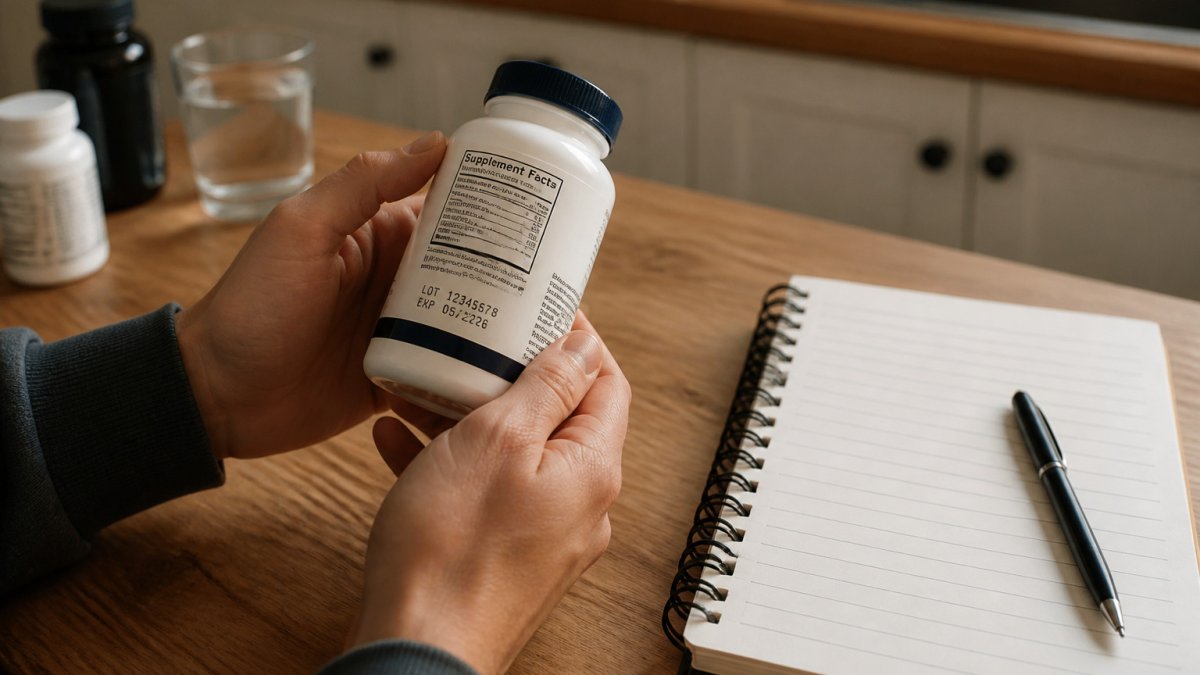
Look for these details:
- Exact ingredient names and forms. "Milk thistle extract" with a standardized silymarin percentage is more specific than "milk thistle."
- Amount per serving. An amount in milligrams or micrograms should be listed, not just "proprietary blend."
- Proprietary blends. Blends hide individual amounts. This is a reason to ask for more information.
Vague labels are a warning sign. If you cannot tell how much of a key ingredient you are getting, the product is harder to verify.
Compare the label against the rest of the product page. Claims should match what appears on the bottle.
For a deeper look at reading labels, see our guide to [how to read supplement labels].
Step 4: Request and Interpret a Certificate of Analysis
A certificate of analysis, often called a COA, is a lab report tied to a specific batch. It is the closest thing a consumer can get to seeing the actual test data behind a bottle. Reputable manufacturers can provide one on request, and some post them online by lot number. The skill worth building is not just asking for a COA, it is reading one well enough to tell a meaningful report from a decorative one.
What a useful COA must contain
Before you read the results, confirm the report has the elements that make it verifiable:
- A lot or batch number that matches your bottle. A COA for a different lot tells you nothing about the product in your hand.
- The testing laboratory's name and its accreditation. Look for accreditation to an internationally recognized program such as ISO/IEC 17025, which is the standard labs are assessed against for testing competence. An unaccredited lab's report carries far less weight.
- The test methods used. For potency, that is typically high-performance liquid chromatography (HPLC); for identity, techniques such as Fourier-transform infrared spectroscopy (FTIR) or mass spectrometry are common. A method name signals the lab actually ran a recognized procedure.
How to read the results like a reviewer
Work through the COA in this order:
- Match the lot. Confirm the lot number on the report matches the code printed on your bottle. If it does not, stop, you have the wrong document.
- Check the lab's accreditation. If the report does not name an accredited lab, treat the results as weaker evidence.
- Read the specification column first. For each test, find the acceptance range, then see whether the result falls inside it. A potency result of 98% of label claim means little until you know the spec was, say, 90-110%.
- Look at the test scope. A COA that only checks identity is not the same as one that also covers potency, microbial contamination, heavy metals, and adulterants. Note what was tested and, just as important, what was not.
- Check the date and the method. Recent results from a recognized method are stronger than old results from an unnamed procedure.
Red flags in a COA
- Results with no specification or acceptance range to compare against.
- No lot number, or a lot number that does not match the bottle.
- No lab name, or a lab that cannot be independently confirmed.
Some manufacturers will not share a COA. That does not prove the product is poor, but it means you have less evidence to rely on. When a company does share one, use the checklist above so the document actually informs your decision rather than just reassuring you.
Use this table to scan the key elements a useful certificate of analysis should contain.
| Element | What to look for | Why it matters |
|---|---|---|
| Lot number | Matches the code on your bottle | Confirms the report covers your product |
| Lab accreditation | ISO/IEC 17025 | Shows the lab is assessed for testing competence |
| Test methods | e.g. HPLC, FTIR, mass spectrometry | Shows a recognized procedure was run |
| Specifications | Stated acceptance range per test | Lets you judge pass or fail |
| Pass or fail finding | Lab's conclusion per test | Gives a clear verdict, not just figures |
| Test date | Recent completion date | Old results may not match your batch |
| Independence | Lab not owned by the manufacturer | Reduces conflict of interest |
Step 5: Check Batch Traceability and Manufacturing Practices
Traceability means you can follow a bottle back to the batch it came from, the raw materials used, and the facility that made it. It is the difference between a product that was tested once and a product that is controlled batch after batch. This is where many seal-focused guides stop, and it is where a careful buyer can go further.
One-time testing versus ongoing control
These are not the same thing, and the distinction matters:
- A one-time test confirms a single batch at a single moment. It says nothing about the next lot.
- Periodic surveillance means a certifier or manufacturer tests samples at intervals. Better than a one-time test, but gaps between checks remain.
- Lot-by-lot testing means every batch is tested before release, with results tied to that lot's code. This is the strongest pattern a consumer can look for, because the evidence follows the specific bottle.
When you evaluate a brand, ask which of these three it actually does. A company that tests every lot and publishes or shares results by lot number is giving you far more than one that tested a single batch years ago.
Verify the lot in your hand
Run these checks on the package you bought:
- Find the lot code and expiration date. They are usually printed on the bottom or side of the bottle, sometimes stamped on the label. If the code is missing, smudged, or unreadable, verification is impossible, treat that as a red flag.
- Match the lot to available records. If the manufacturer posts COAs by lot, confirm yours is listed. If not, request the COA for your specific lot, not a generic sample report.
- Confirm the facility and its practices. Ask whether the product was made in a facility that follows FDA current good manufacturing practice regulations for dietary supplements. GMP compliance covers things like identity testing of incoming ingredients, process controls, and recordkeeping, the systems that make lot-level traceability possible in the first place.
- Check for third-party facility audits. A site audit by an independent organization adds evidence that the manufacturing environment, not just the finished product, was reviewed.
- Search recall history. Before you buy, check FDA recall notices for the brand. A pattern of recalls is a signal that quality control is not holding.
What traceability does and does not prove
Good traceability shows that the company can link a bottle to its batch, its ingredients, and its test results. It does not, by itself, prove the product is effective, appropriate for every person, or approved by the FDA, supplements are not approved before sale.
If a company cannot tell you where a lot was made or show results tied to that lot, treat it as a red flag, even if the front of the bottle looks reassuring.
Using Your Checklist Before Your Next Supplement Purchase
Run through the five steps before you buy. Start with the seal, confirm it is current, read the label, request a COA if you need more proof, and check traceability and manufacturing details. Write your findings down so you can compare products side by side.
Many buyers find the checks take only a few minutes once they have done them a few times. If a product fails two or more steps, consider skipping it, even if the price is attractive.
If you are looking at liver health supplements, you can check the criteria above against [Renew Liver Booster].
Frequently Asked Questions
How can I verify the authenticity of a supplement?
Start by checking the label for a recognized third-party seal such as USP Verified, then confirm the product is listed in the certifier's public database under the same brand, product name and dosage. Look for a lot number and expiration date, and compare the ingredient list and strength with the manufacturer's website. If the seal cannot be confirmed in the certifier's own records, treat the claim as unverified. A seal is strong evidence, but it applies only to the batches the certifier tested, so confirm the lot you are buying when you can.
What does third-party testing mean for dietary supplements?
Third-party testing means an independent organization, not the brand itself, evaluates a product against published standards. Testing typically checks whether the listed ingredients are present, whether the amounts match the label, and whether contaminants such as heavy metals or microbes are within acceptable limits. Independent verification programs also audit manufacturing practices at the facility. The result is a better basis for trust than the brand's own claims, but it does not prove a product will produce any particular health outcome.
Can I verify a supplement's ingredients with a certificate of analysis?
Yes, if the company will provide one. A certificate of analysis for a specific lot lists test results such as identity, potency, purity and microbial counts, along with the laboratory that performed the tests and the testing date. Compare the potency numbers against the label claim and check that the lot number matches the bottle you hold. A certificate from the brand's own lab is less independent than one from an accredited outside laboratory, so note who issued it.
How can I check whether a supplement certification is legitimate?
Go to the certifying organization's website and search its public product database rather than relying on a logo alone. Confirm the brand name, product name, serving size and certification status are all current. Watch for seals printed on labels that do not appear in any database, and for certificates that cannot be traced to a named certifier. Counterfeit seals exist, so a search on the official site is the most reliable check.
Verifying supplement quality takes time, but it is the only way to know what is really in the bottle. Use this checklist each time you buy, and keep records of the results.
