

Last Updated: October 30, 2026
Quick Summary
Amway and Metagenics sell through different models, so the right choice depends on the product label rather than the brand name. Compare serving size, per-serving milligrams of each active ingredient, third-party testing, and cost per serving before deciding between amway vs metagenics options.
- Read the Supplement Facts panel and compare per-serving milligrams of each active ingredient.
- Flag any ingredient hidden inside a proprietary blend, since its dose cannot be verified.
- Divide bottle price by servings per container to get cost per serving.
- Look for a certificate of analysis or recognized third-party testing seal.
- Confirm any interactions with your doctor or pharmacist before starting a liver supplement.
Table of Contents
- Amway vs Metagenics at a Glance: Who Each Brand Is
- How to Compare Supplement Labels Side by Side
- Ingredient Amounts, Forms, and What the Label Actually Discloses
- Testing, Quality Control, and Evidence Quality
- Price and Value per Serving
- Liver Support Options: Where Milk Thistle Fits In
- Safety, Interactions, and Questions to Ask Your Doctor
- Choosing Your Next Step on Liver Support
- Frequently Asked Questions
Amway vs Metagenics at a Glance: Who Each Brand Is
Choosing between Amway and Metagenics supplements is harder than it looks, and the amway vs metagenics comparison hinges on the two companies selling through very different models. Renew Liver Booster, a dietary supplement built around turmeric, milk thistle, and beet root, sits in a separate category altogether. We wrote this guide to help you compare these options on the criteria that actually matter for liver support.
When comparing any supplement brand, check each product's label rather than rely on the brand name.
Watch out: Brand reputation is not the same as product quality. Judge each formula on its ingredients, doses, and testing, not on how familiar the company feels.
How to Compare Supplement Labels Side by Side
A useful comparison starts with the Supplement Facts panel. Put two bottles next to each other and read the serving size, the number of servings per container, and the amount of each active ingredient. Then check the "other ingredients" list for fillers, binders, and colorants.
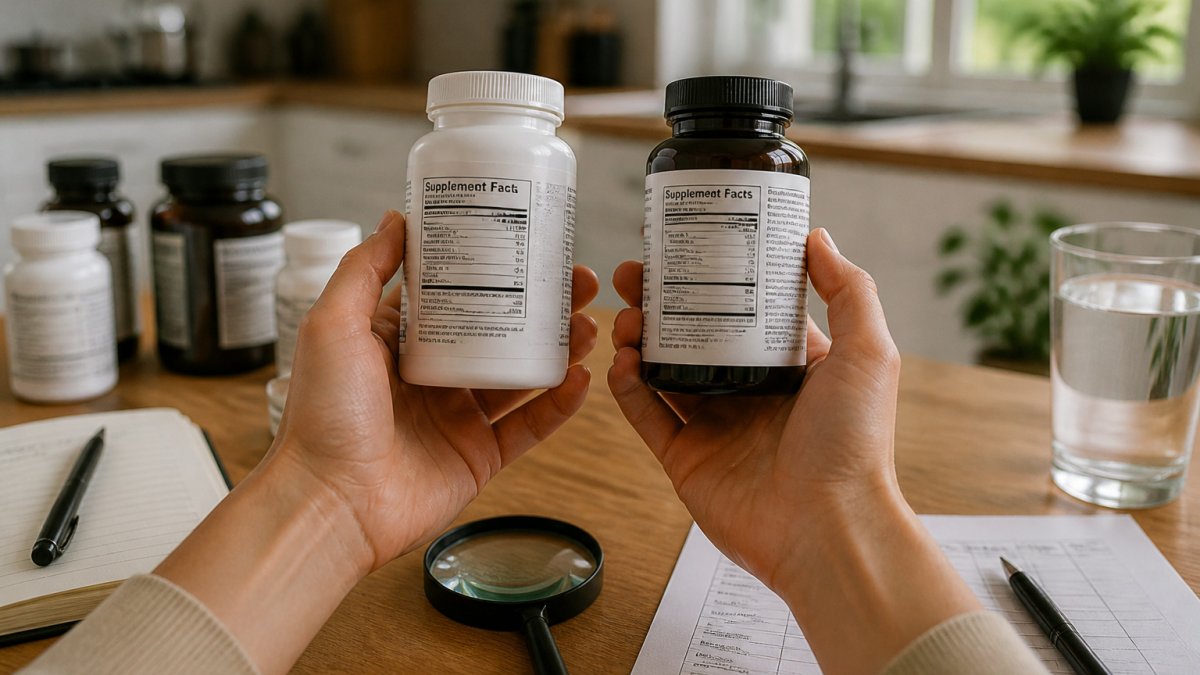
Work through a simple checklist:
- Confirm the serving size and servings per container.
- Note the milligram amount of each active ingredient per serving.
- Identify the form of each ingredient, such as extract, powder, or standardized compound.
- Check for allergens and any ingredients you avoid.
- Look for a lot number, expiration date, and manufacturer contact information.
Compare the numbers directly. A higher total weight per capsule does not always mean more active ingredient, so focus on the per-serving amount of each compound.
Ingredient Amounts, Forms, and What the Label Actually Discloses
This is where most brand comparisons fall apart. The useful exercise is to run the same three checks on any two supplement labels and see what each label does and does not tell you.
Check 1: Is each active ingredient dosed individually, or hidden in a blend? A proprietary blend lists a total milligram weight for several ingredients without breaking out each one. That makes cost-per-milligram math impossible and makes it impossible to compare against a competitor's single-ingredient product. When you pull up a supplement label, look for a blend line first. If the ingredients you care about sit inside a blend, you cannot verify the dose, and the label is telling you less than it appears to.
Check 2: Is the ingredient form named, and is it standardized? "Milk thistle seed extract" is not the same disclosure as "milk thistle seed extract standardized to 80% silymarin." The second tells you how much of the active compound you actually get per serving; the first does not. The same logic applies to curcumin in turmeric, to the specific vitamin E tocopherols used, and to mineral forms such as oxide versus citrate versus glycinate, which differ in absorption. The label, not the brand, is the deciding factor.
Check 3: Does the label disclose the full "other ingredients" list and the allergen statement? Fillers, binders, flow agents, and colorants are legally part of the formula even though they are not active. Compare the two labels line by line and note anything you avoid.
A practical side-by-side method:
- Write down the serving size and servings per container for each product.
- Record the milligram amount of every active ingredient per serving, not per capsule.
- Note the form and standardization percentage wherever stated.
- Flag every ingredient that appears only inside a blend.
- Compare the two lists and count how many actives you can actually verify.
The product with more verifiable actives is the one you can meaningfully compare; the one with more blend-only entries is the one you have to take on faith. If a label leaves a question open, contact the manufacturer for a lot-specific answer before you buy.
Testing, Quality Control, and Evidence Quality
Quality control is one of the most important differences between supplement brands, and it is also one of the hardest to verify from a shelf label. Independent third-party testing, where an outside lab checks identity, potency, and contaminants, offers stronger assurance than in-house claims. Look for a certificate of analysis, a lot-specific testing statement, or a recognized third-party seal on any product you consider.
Evidence quality matters too. Many supplement claims rest on small studies, animal research, or traditional use rather than large clinical trials. The National Institutes of Health's Office of Dietary Supplements publishes fact sheets on individual ingredients, including milk thistle and turmeric, and these are a reliable starting point for understanding what the research shows and where it is limited.
NIH Office of Dietary Supplements fact sheets on milk thistle and turmeric
Price and Value per Serving
Price is the section competitors handle worst, usually by skipping it. The fix is a repeatable method plus the retailer and subscription context that actually changes what you pay.
Step 1: Normalize to cost per serving, not cost per bottle. Divide the bottle price by the number of servings per container. A 60-capsule bottle taken two capsules per day is a 30-serving bottle, so a $30 bottle is $1.00 per serving, not $0.50 per capsule. Do this for every product on your short list before comparing anything else.
Step 2: Normalize to cost per unit of the active ingredient you want. If a milk thistle product discloses 150 mg of silymarin per serving and another discloses 80 mg, the per-serving price alone misleads you. Divide the cost per serving by the milligrams of the target compound to get cost per milligram, then compare like with like. This is the step that turns a price list into a value comparison.
Step 3: Account for how each brand is actually sold. Pricing for any supplement can depend on the retailer, quantity, promotion, and subscription status, so confirm the current total at the point of sale.
Step 4: Check subscription and auto-ship terms. Recurring-order discounts are available on some products. A discount is only a saving if you actually want the product on that schedule, so read the cancellation and minimum-order terms before enrolling.
Step 5: Weigh value against disclosure. A cheaper product with blend-only ingredients can cost more in practice, because you cannot confirm you are getting the dose you are paying for. Rank your short list on three columns side by side: cost per serving, cost per milligram of the target active, and number of actives the label fully discloses. The product that wins on all three is the better value; the one that wins only on price is the one to scrutinize.
For Renew Liver Booster pricing, visit the brand's website for current prices and serving information so you can run the same three-column comparison.
Comparing cost per serving and per milligram of the target ingredient gives a clearer picture than the bottle price alone.
| Step | What to do | Note |
|---|---|---|
| 1 | Divide bottle price by servings per container | Gives cost per serving, not per capsule |
| 2 | Divide cost per serving by target milligrams | Gives cost per milligram of the active |
| 3 | Confirm current total at point of sale | Prices vary by retailer and promotion |
| 4 | Read subscription and cancellation terms | Discounts only help if you want the schedule |
| 5 | Rank on cost, cost per milligram, disclosed actives | Price alone can mislead |
Liver Support Options: Where Milk Thistle Fits In
Renew Liver Booster is formulated with milk thistle, turmeric, and beet root. Milk thistle's active compounds, collectively called silymarin, are the focus of much of the research, which is why a standardized silymarin amount is worth checking on any label.
Supplements do not replace medical care for liver disease. If you have been diagnosed with fatty liver or another liver condition, a supplement is best considered as one part of a plan your doctor approves, alongside diet, activity, and monitoring. Evidence for specific benefits is still developing, so set realistic expectations.
Safety, Interactions, and Questions to Ask Your Doctor
Supplements can interact with prescription medicines, and liver-focused products deserve particular care because the liver processes many drugs. Before starting any product, review its full ingredient list with your doctor or pharmacist, especially if you take blood thinners, diabetes medications, cholesterol drugs, or other daily prescriptions.
Bring these questions to your next appointment:
- Is a liver supplement appropriate given my diagnosis and medications?
- Which ingredients in this product could interact with my prescriptions?
- What symptoms should prompt me to stop taking it and call you?
- How will we measure whether it is helping?
The FDA regulates dietary supplements under a different framework than prescription drugs, so manufacturers do not need to prove effectiveness before sale (the FDA). Check the FDA's dietary supplement resources for more on how these products are regulated.
FDA guidance on dietary supplements and what consumers should know
Choosing Your Next Step on Liver Support
Start with a short list of two or three products, then compare their labels on ingredient amounts, testing, and cost per serving using the checklist above. Confirm any interactions with your healthcare provider before you buy. If you want a closer look at how Renew Liver Booster is formulated, review its label and testing information on the brand's website.
Frequently Asked Questions
What companies does Amway own?
When comparing supplements from different brands, check each product's label directly rather than assuming shared standards.
Is Nutrilite owned by Amway?
Compare the specific product label, including ingredient amounts and serving size, because the brand name alone does not tell you how a given formula compares to another.
Do Amway or Metagenics supplements support liver health?
Supplements are not intended to treat, cure, or reverse liver disease. If you have fatty liver or abnormal liver test results, a supplement should only supplement a plan your doctor has set, not replace it.
What should I ask a healthcare professional before taking a liver supplement?
Ask whether the supplement could interact with any prescription or over-the-counter medications you take, and whether any ingredient is a concern given your liver test results. Bring the full label so your clinician can check ingredient amounts and forms. Ask what monitoring is appropriate, and how long you should try a product before reassessing. A clinician can also tell you whether lifestyle changes such as weight loss, alcohol reduction, and exercise should come first.
Renew Liver Booster is a dietary supplement formulated with turmeric, milk thistle, and beet root. It is made in the USA with clear labeling and is tested for purity. Visit the Renew Liver Booster website to review the label, check current pricing, and add to cart when you are ready.
